
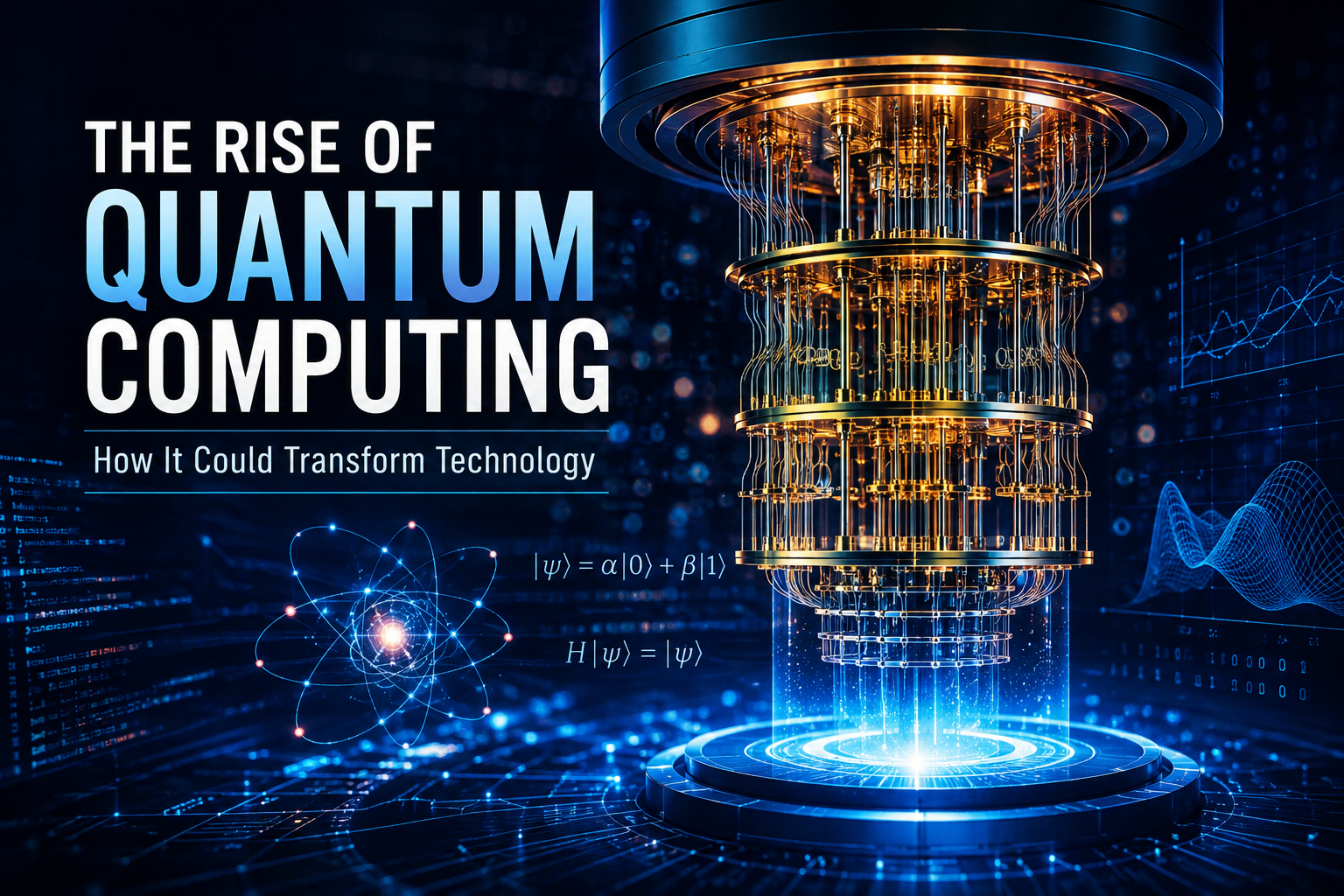
Quantum computing is emerging as one of the most important technological developments of the 21st century. While traditional computers have transformed nearly every part of modern life, quantum computers approach computation in a fundamentally different way. Instead of relying only on classical bits that represent either 0 or 1, quantum computers use quantum bits, or qubits, which can take advantage of quantum mechanical phenomena to process certain types of problems in new ways.
Although large-scale, fault-tolerant quantum computing is still developing, researchers and technology companies are investing heavily in the field. The long-term possibilities are significant, ranging from drug discovery and materials science to cybersecurity, logistics, finance, and artificial intelligence.
Understanding Quantum Computing
Traditional computers process information using bits. A bit has a value of either zero or one. Billions of these simple operations can be combined to perform complex calculations.
Quantum computers use qubits. A qubit can exist in a combination of states through a phenomenon called superposition. Qubits can also become correlated through quantum entanglement. These properties allow quantum algorithms to approach certain computational problems differently from classical algorithms.
This does not mean quantum computers will replace ordinary computers for everyday activities. A smartphone, office computer, or gaming PC is already highly efficient for many conventional tasks. Quantum machines are more promising for specialized problems where quantum algorithms can provide meaningful advantages.
Why Quantum Computing Matters
Some problems become extraordinarily difficult as their size increases. Simulating complex molecules, optimizing large networks, or searching enormous mathematical spaces can require tremendous computational resources.
Quantum computing could eventually help researchers investigate these problems more efficiently.
One major opportunity is scientific simulation. Nature itself operates according to quantum mechanics at microscopic scales. Quantum computers may therefore provide useful tools for modeling molecules, chemical reactions, and new materials.
This could influence pharmaceutical research, battery development, industrial chemistry, and energy technology.
Quantum Computing and Healthcare
Healthcare is one of the fields that could benefit from more powerful computational tools.
Drug discovery involves examining enormous numbers of molecular structures and interactions. Researchers need to understand how compounds behave and whether they can interact with biological targets.
Quantum computing could eventually help simulate molecular behavior with greater sophistication. This may support the discovery of potential drug candidates and materials.
The technology could also contribute to personalized medicine, where researchers analyze large amounts of biological and patient data to identify treatment patterns.
However, quantum computing should not be viewed as a magical solution. Developing useful quantum algorithms for biological problems remains an active research challenge.
The Connection Between Quantum Computing and Artificial Intelligence
Artificial intelligence is another area where quantum computing has attracted attention.
Modern AI systems require substantial computational resources, particularly during model training and optimization. Researchers are exploring whether quantum algorithms could eventually improve selected optimization, machine learning, or sampling tasks.
This emerging field is sometimes described as quantum machine learning.
The relationship could work in both directions. Quantum computers may eventually assist AI, while AI can also help improve quantum technologies by optimizing control systems, correcting errors, and analyzing experimental results.
For now, most practical AI workloads remain firmly based on classical computing infrastructure.
Cybersecurity Implications
Quantum computing presents both opportunities and challenges for cybersecurity.
Many widely used cryptographic systems rely on mathematical problems that are extremely difficult for classical computers. A sufficiently powerful quantum computer could threaten some of these systems using quantum algorithms.
This has led to the development of post-quantum cryptography, which aims to create encryption methods designed to withstand attacks from both classical and quantum computers.
Organizations do not necessarily need to wait for powerful quantum machines to appear before thinking about the issue. Sensitive information encrypted today may remain valuable for many years. This creates a concern sometimes called “harvest now, decrypt later,” where encrypted data could potentially be collected today and targeted in the future.
Quantum Computing in Finance
Financial institutions regularly solve optimization and modeling problems involving portfolios, pricing, risk, and trading.
Quantum algorithms may eventually help address selected optimization problems more efficiently.
For example, portfolio optimization can involve balancing risk and expected return across many assets while considering multiple constraints. Quantum approaches are being studied as possible tools for complex optimization.
The financial sector is therefore one of the industries actively monitoring quantum developments.
Challenges Facing Quantum Technology
Quantum computing has enormous potential, but it also faces serious technical obstacles.
Qubits are extremely sensitive to their environment. Noise, temperature fluctuations, electromagnetic interference, and other disturbances can introduce errors.
Quantum error correction is therefore a central area of research. Building reliable logical qubits from many physical qubits requires sophisticated engineering.
Another challenge is scalability. Demonstrating a quantum processor in a laboratory is very different from creating a large machine capable of solving commercially important problems reliably.
The infrastructure required for some quantum systems can also be complex and expensive.
Quantum Computing and the Future of Work
The growth of quantum computing could create new career opportunities in physics, mathematics, computer science, engineering, cybersecurity, and software development.
Importantly, the industry will need more than quantum physicists. Developers will need to create algorithms and applications, while cybersecurity professionals will help organizations prepare for post-quantum security.
Universities and technology companies are already expanding educational programs and research initiatives related to quantum technologies.
Will Quantum Computers Replace Traditional Computers?
Probably not.
Quantum and classical computers are likely to coexist. Classical systems are excellent for everyday computing tasks, while quantum processors may become specialized accelerators for certain difficult problems.
A future computing environment could combine conventional CPUs, GPUs, specialized AI accelerators, and quantum processors.
This hybrid model may allow organizations to use the right technology for each workload.
What Comes Next?
The future of quantum computing will depend on progress in hardware, error correction, algorithms, software tools, and practical applications.
The most important milestone will not simply be building a machine with more qubits. Researchers need to demonstrate reliable computational advantages on useful real-world problems.
As the technology matures, industries will increasingly experiment with quantum applications. Some experiments will fail, while others may reveal entirely new approaches to difficult problems.
Conclusion
Quantum computing represents a major shift in how humanity thinks about computation. It is still an emerging technology, and many of its most ambitious promises remain unproven at commercial scale. Nevertheless, its potential impact on science, healthcare, cybersecurity, finance, materials, and artificial intelligence makes it an important technology to watch.
The coming years will likely focus on making quantum systems more reliable, scalable, and useful. If researchers overcome the industry’s major engineering challenges, quantum computing could become an important part of the future computing landscape.