Technology has traditionally separated the digital world from the physical world. We interact with computers through screens, keyboards, smartphones, and other interfaces. Spatial computing is beginning to challenge this separation by allowing digital information to interact more naturally with physical environments.
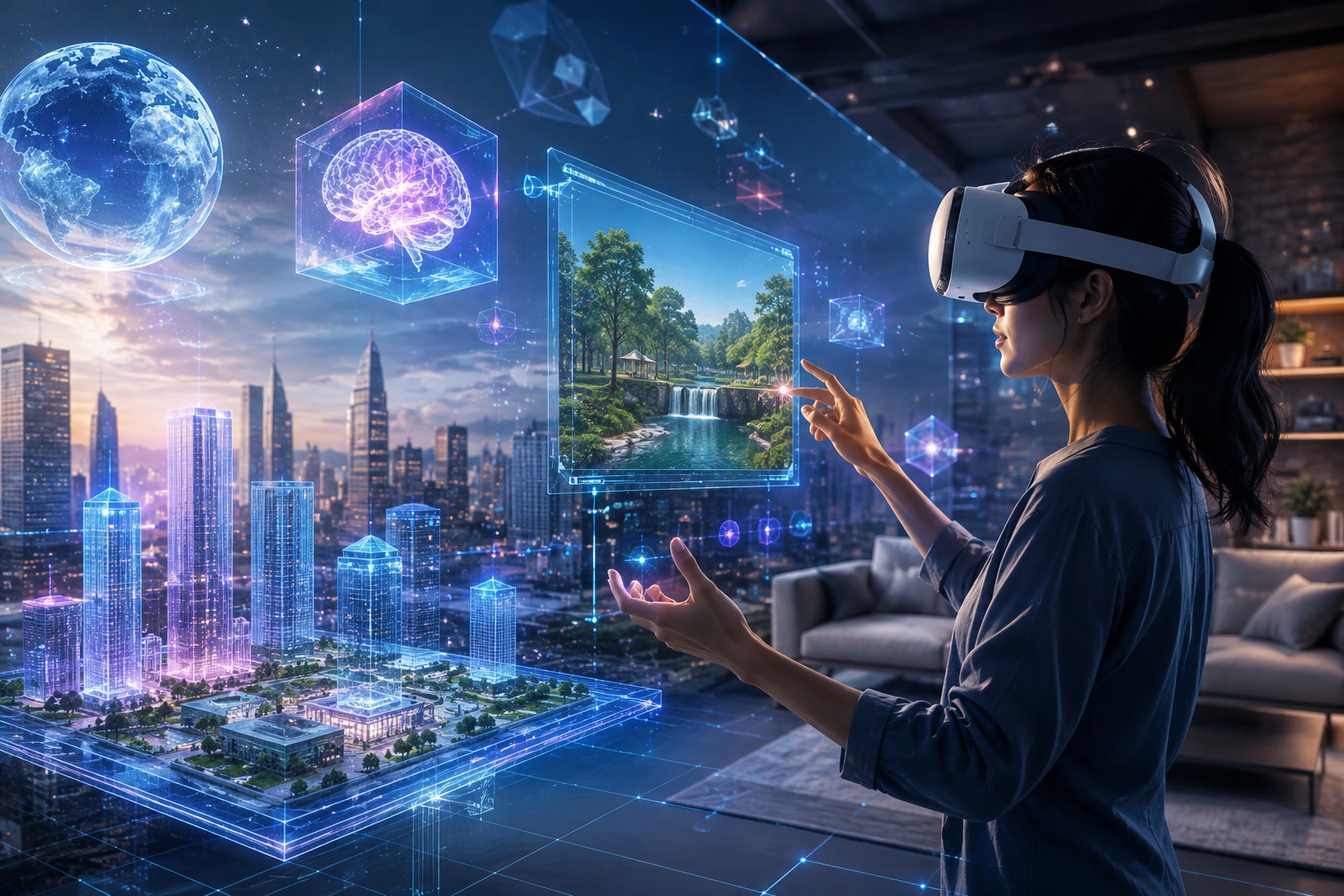
Spatial computing combines technologies such as augmented reality, virtual reality, mixed reality, computer vision, sensors, artificial intelligence, and three-dimensional interfaces. Instead of simply looking at information on a flat screen, users can increasingly interact with digital objects as though they occupy physical space.
This emerging technology could influence entertainment, education, healthcare, manufacturing, retail, architecture, and everyday communication.
What Is Spatial Computing?
Spatial computing refers broadly to technologies that allow computers to understand and interact with the physical space around a user.
A spatial computing system can use cameras, sensors, positioning technology, and software to understand elements such as surfaces, objects, movement, and depth.
Augmented reality can place digital information over the physical world. Virtual reality can create fully digital environments. Mixed reality combines digital content with an understanding of physical surroundings.
Together, these technologies create new ways to interact with information.
Why Spatial Computing Is Important
Most digital interfaces still rely on two-dimensional displays. Spatial computing introduces another dimension: physical space.
Imagine an engineer examining a three-dimensional model of a machine before manufacturing it. Instead of viewing the model on a computer monitor, the engineer could inspect it as a virtual object in the room.
Similarly, an architect could walk around a digital building model before construction begins.
These experiences can make complex information easier to understand.
Transforming Education
Education is one of the areas where spatial computing could have a significant impact.
Traditional textbooks and diagrams are useful, but three-dimensional experiences can provide additional context.
Students learning anatomy could examine virtual human organs. Geography students could explore interactive three-dimensional environments. History students could experience reconstructions of historical locations.
Virtual laboratories could also allow students to conduct simulations without requiring expensive physical equipment.
This does not mean traditional teaching methods will disappear. Instead, spatial technology can become another tool that teachers use when visualization adds value.
Healthcare Applications
Healthcare professionals deal with complex three-dimensional information every day.
Medical imaging can generate detailed representations of internal structures. Spatial computing may allow doctors to visualize these structures in more intuitive ways.
Surgeons could potentially use three-dimensional models to prepare for complicated procedures. Medical students could practice using simulated environments before working with real patients.
Rehabilitation is another promising area. Virtual environments can support certain forms of physical and cognitive therapy under professional supervision.
However, medical applications require high standards for safety, accuracy, privacy, and validation.
Manufacturing and Engineering
Industrial companies are exploring spatial computing for design, maintenance, training, and remote assistance.
Engineers can use digital models to examine equipment before physical prototypes are built.
Technicians can potentially view instructions or diagrams overlaid on machinery while performing maintenance.
Training workers through simulated environments can also reduce the need to interrupt production for certain training exercises.
Digital twins can strengthen these applications. A digital twin is a digital representation of a physical asset, system, or process that can be updated using real-world information.
When combined with spatial interfaces, digital twins can become easier to explore and understand.
Retail and Shopping
Spatial computing could also change how people shop.
Instead of imagining what a product might look like in their home, customers could use augmented reality to visualize furniture, appliances, decorations, or other products within their actual environment.
Fashion applications may allow users to preview clothing or accessories digitally.
These technologies can reduce uncertainty during online purchasing and potentially improve the customer experience.
Retail businesses must nevertheless make sure that digital representations accurately reflect real products.
Entertainment and Gaming
Gaming has been one of the most visible areas for immersive technologies.
Virtual and mixed reality can create interactive environments in which users become participants rather than passive viewers.
Games can use physical movement, spatial audio, hand tracking, and environmental awareness to produce immersive experiences.
Beyond gaming, concerts, sports experiences, museums, and interactive storytelling could use spatial computing to create new entertainment formats.
The Role of Artificial Intelligence
Artificial intelligence is becoming increasingly important to spatial computing.
AI can help devices understand images, recognize objects, interpret voice commands, track movement, and generate digital content.
For example, an intelligent spatial assistant could recognize a table, understand where objects are located, and respond to natural-language instructions.
Generative AI could also create three-dimensional objects, environments, and virtual characters from simple descriptions.
This combination could make spatial computing easier for ordinary users.
Challenges and Limitations
Spatial computing faces several challenges.
Hardware remains one of the biggest barriers. Headsets and wearable devices need to become lighter, more comfortable, affordable, and energy efficient.
Motion tracking must also be accurate. Delays or errors can reduce the quality of immersive experiences and may cause discomfort.
Privacy is another concern. Spatial devices can collect information about homes, workplaces, faces, movements, and surroundings.
Companies will need strong privacy policies and security measures to prevent misuse.
The Future Workplace
Spatial computing may change how teams collaborate.
Remote employees could meet inside shared virtual environments, examine three-dimensional models, and interact with digital objects together.
Architects, engineers, designers, and researchers could collaborate on virtual prototypes from different locations.
As communication technologies improve, meetings may become less dependent on traditional video-call interfaces.
What the Future Could Look Like
Future spatial computing devices may become less noticeable and more integrated into everyday life.
Instead of carrying multiple devices, users may interact with digital information through lightweight glasses, voice interfaces, gestures, and environmental displays.
Digital content could become context-aware, appearing when and where it is useful.
For example, a traveler could see navigation information overlaid onto streets, while a technician could receive maintenance instructions directly over a machine.
Conclusion
Spatial computing is redefining the relationship between people, computers, and physical environments. By combining augmented reality, virtual reality, artificial intelligence, computer vision, and sensors, it creates opportunities for more natural digital interaction.
Its future will depend on improvements in hardware, software, affordability, privacy, and usability. While widespread adoption may take time, spatial computing has the potential to influence how people learn, work, shop, design, communicate, and experience entertainment.
The next generation of computing may not simply happen on screens. Increasingly, it may happen around us.