Introduction
Technology is evolving beyond smartphones, computers, and wearable devices. A new approach called ambient computing is changing how people interact with digital systems by allowing technology to operate quietly in the background. Instead of requiring users to open applications, press buttons, or issue commands for every task, ambient computing enables connected devices and intelligent systems to respond to people’s needs, routines, and surroundings.
From homes that automatically adjust lighting to workplaces that optimize energy consumption, this technology is creating environments that can anticipate requirements and simplify everyday activities. It combines artificial intelligence, sensors, connected devices, cloud computing, and automation to deliver more natural digital experiences.
Unlike traditional technology, which often demands constant attention, ambient computing aims to make digital assistance available without making technology itself the center of attention.
As connected environments become more sophisticated, ambient computing could influence how people live, work, travel, shop, and interact with public infrastructure. However, its development also raises important questions about privacy, security, accessibility, and the appropriate role of automation.
Understanding ambient computing helps explain an important direction in modern technology: the movement from devices that people actively operate toward intelligent environments that respond to them.
What Is Ambient Computing?
Ambient computing is an approach to technology in which digital systems operate in the background and interact with users through their surroundings. These systems combine information from sensors, connected devices, software, and intelligent algorithms to provide assistance with minimal manual interaction.
For example, a smart office might recognize that a meeting is about to begin and automatically adjust the room temperature, activate the presentation display, and prepare the necessary collaboration tools. Employees would not need to configure each system individually.
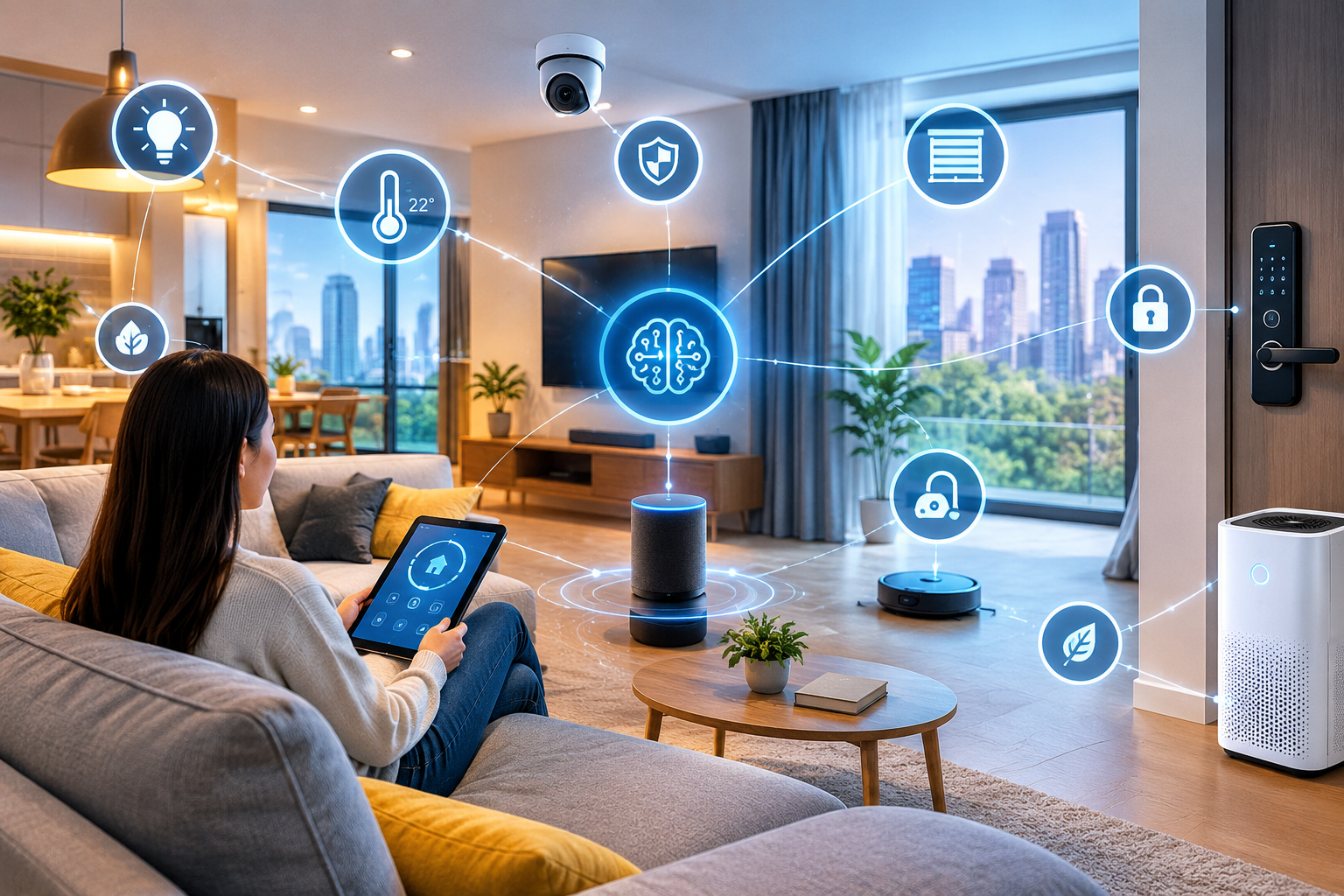
Similarly, a connected home could adjust lighting according to the time of day, reduce heating when rooms are empty, and notify residents about unusual activity.
The central idea is to make technology more integrated into everyday environments.
Ambient computing does not necessarily mean that devices must be invisible. Smart speakers, sensors, displays, and connected appliances may remain physically noticeable. The important distinction is that users do not need to manage every interaction manually.
This approach builds on several established technology fields, including the Internet of Things, artificial intelligence, machine learning, voice recognition, edge computing, and wireless communication.
When these technologies work together effectively, they can create environments that are more responsive, efficient, and convenient.
How Ambient Computing Works
Ambient computing depends on several technological components working together. Each component performs a specific role in collecting information, interpreting situations, and responding appropriately.
1. Sensors Collect Environmental Information
Sensors help digital systems understand what is happening in their surroundings.
Depending on the application, sensors may detect movement, temperature, humidity, light intensity, sound levels, air quality, or the presence of people.
In a smart building, occupancy sensors can identify whether a room is being used. The building management system can then adjust lighting and ventilation according to actual demand.
Environmental sensors can also identify conditions that require attention. For instance, a water-leak sensor may notify a property owner when moisture is detected in an unexpected location.
Sensors provide the information needed for responsive automation. However, their effectiveness depends on accurate readings, appropriate placement, and careful consideration of privacy.
2. Artificial Intelligence Interprets Information
Collecting data is only the first step. Intelligent software must determine what the information means and whether an action is appropriate.
Artificial intelligence can identify patterns, interpret commands, classify environmental conditions, and help systems make decisions.
For example, a smart home system might learn that residents usually reduce lighting in the evening. It could suggest an automated lighting schedule based on those preferences.
More advanced systems may combine several signals to understand a situation. A building might use occupancy information, temperature readings, and electricity demand to optimize its heating and cooling systems.
Nevertheless, predictions are not always correct. Well-designed systems need safeguards, clear settings, and options for users to override automated decisions.
3. Connected Devices Communicate
Ambient computing requires different devices and applications to exchange information.
Smart lights, thermostats, security systems, appliances, displays, and other connected equipment may communicate through local networks, wireless protocols, or internet-based services.
Interoperability is especially important because devices from different manufacturers do not always work together seamlessly.
Standards such as Matter are intended to improve compatibility among supported smart-home products. Better interoperability can reduce the complexity of managing connected environments and make it easier for consumers to choose devices from different brands.
4. Edge Computing Enables Faster Responses
Some ambient computing applications require immediate responses.
Edge computing allows certain data processing tasks to take place on local devices or nearby computing equipment instead of sending every request to a distant cloud server.
For example, a local security system may detect movement and activate an alert without waiting for a cloud service to process the information.
Local processing can reduce latency, improve reliability during internet disruptions, and limit the amount of sensitive information transmitted externally.
Cloud computing remains valuable for tasks that require substantial computing resources, centralized management, or information from multiple locations.
In practice, ambient computing systems may combine edge and cloud processing according to their requirements.
Major Applications of Ambient Computing
Ambient computing has potential applications across homes, offices, healthcare, transportation, retail, and public infrastructure.
1. Smarter Homes and Everyday Living
Smart homes are among the most accessible examples of ambient computing.
Traditional smart-home products often require users to control individual devices through mobile applications or voice commands. Ambient systems aim to coordinate these products so that routine tasks happen automatically.
For example, a connected home could reduce unnecessary lighting when rooms are unoccupied, adjust the thermostat according to a preferred schedule, and remind residents when maintenance is required.
A morning routine might involve gradually increasing bedroom lighting, adjusting the temperature, and displaying relevant calendar information.
These features can reduce repetitive tasks and improve convenience.
Energy management is another important application. By analyzing electricity consumption and environmental conditions, connected systems can help households identify waste and manage energy use more efficiently.
However, homeowners should retain control over important functions. Automatic door unlocking, security settings, and other sensitive actions require stronger safeguards than ordinary lighting adjustments.
2. Intelligent Offices and Workplaces
Modern workplaces contain numerous digital systems, including lighting controls, meeting-room displays, access-management tools, air-conditioning equipment, and collaboration platforms.
Managing these systems separately can create unnecessary complexity.
Ambient computing can coordinate workplace technology according to occupancy, schedules, and environmental conditions.
For instance, a meeting room could prepare its display and conferencing equipment before a scheduled meeting. Lighting and ventilation could respond to room occupancy rather than following a fixed schedule throughout the day.
These capabilities may improve employee comfort while reducing wasted energy.
Office managers could also use aggregated building data to understand how spaces are used and determine whether room layouts need to change.
Organizations must nevertheless establish clear policies about employee monitoring. Workplace automation should improve building operations without becoming an excuse for excessive surveillance.
3. Healthcare and Assisted Living
Healthcare environments can benefit from technologies that provide timely information without requiring constant manual interaction.
Connected sensors may help monitor room conditions, equipment availability, and certain patient-related measurements when used within appropriate medical systems.
In assisted-living environments, carefully designed automation can support everyday independence. For example, motion sensors and connected lighting can help illuminate pathways at night, while environmental monitoring can alert staff to certain safety concerns.
Ambient technology may also support healthcare professionals by reducing repetitive administrative work and helping them access relevant information.
However, healthcare applications require particularly careful implementation. Medical decisions should not rely blindly on automated predictions, and systems must meet applicable requirements for patient privacy, reliability, and clinical safety.
Ambient computing should support qualified professionals and patients rather than replace necessary medical judgment.
4. Connected Transportation
Transportation systems increasingly rely on sensors, communications networks, software, and real-time information.
Ambient computing can help coordinate the digital systems surrounding vehicles, passengers, and transportation infrastructure.
For example, a connected parking facility could direct drivers toward available spaces. Public transportation stations might display updated passenger information based on operational conditions. Building entrances could provide accessible directions to visitors through connected displays or mobile devices.
Within vehicles, contextual systems may adjust navigation information, climate settings, and entertainment preferences according to driver-selected settings and travel conditions.
Safety must remain the priority. Driver-facing systems should minimize distractions and avoid presenting unnecessary notifications while a vehicle is moving.
Automation also needs to account for connectivity failures, inaccurate sensor readings, and unexpected situations.
5. Retail and Customer Experiences
Retail businesses can use connected systems to improve inventory management, store operations, and customer service.
Smart shelves and inventory sensors can help staff identify products that need replenishment. Connected displays may provide relevant product information, while automated environmental controls can improve comfort and reduce unnecessary energy consumption.
In some settings, ambient systems could help customers navigate large stores or locate particular products.
Retailers may also use aggregated occupancy information to understand how customers move through physical spaces.
However, collecting information about individual shoppers introduces privacy concerns. Businesses should clearly explain what information is collected, obtain consent where required, and avoid intrusive tracking.
The most useful retail applications will generally be those that solve practical problems without making customers feel constantly observed.
6. Smart Cities and Public Infrastructure
Cities manage complex networks of roads, streetlights, public buildings, utilities, and transportation services.
Ambient computing principles can help these systems respond to changing conditions.
Smart streetlights, for example, may adjust brightness according to environmental conditions or detected activity where appropriate. Connected infrastructure can also help monitor water systems, identify maintenance requirements, and optimize energy consumption.
Public transportation systems may use sensor information to improve service planning and communicate disruptions more effectively.
These applications can potentially improve resource management and operational efficiency.
Nevertheless, large-scale urban systems require reliable infrastructure, strong cybersecurity, transparent governance, and accessible alternatives for residents who do not use connected devices.
Technology should support public services rather than make essential services dependent on continuous personal tracking.
Benefits of Ambient Computing
The growing interest in ambient computing reflects several potential advantages.
Reduced Manual Effort
One of its most obvious benefits is the reduction of repetitive interactions.
Instead of manually adjusting every device, users can establish preferences and allow suitable tasks to happen automatically.
This can be particularly useful in environments containing numerous connected systems.
Improved Energy Efficiency
Connected systems can adjust electricity use according to occupancy, environmental conditions, and operational requirements.
For example, automated lighting and climate controls may reduce unnecessary consumption in empty rooms.
Actual savings depend on equipment efficiency, system configuration, user behavior, and the energy consumed by the connected infrastructure itself.
More Personalized Experiences
Ambient systems can adapt to individual preferences, such as preferred lighting levels, room temperatures, or notification settings.
Personalization can make technology more comfortable to use, provided that users can inspect, modify, or delete the information used to create these preferences.
Better Accessibility
Voice interfaces, automatic lighting, environmental controls, and contextual assistance can help people interact with technology without relying exclusively on small screens or physical buttons.
These features may be valuable for people with mobility limitations, visual impairments, or other accessibility requirements.
However, ambient systems should include alternatives for people who cannot use voice recognition, automated interfaces, or particular connected devices.
More Efficient Resource Management
Businesses and public organizations can use environmental information to make better operational decisions.
For example, building managers may identify underused rooms, detect abnormal energy consumption, and prioritize maintenance before minor problems become expensive failures.
Challenges and Risks of Ambient Computing
Despite its potential, ambient computing introduces important technical and social challenges.
Privacy and Continuous Data Collection
Ambient systems may rely on information about occupancy, movement, environmental conditions, or user interactions.
When poorly designed, they can collect more information than necessary or make people uncomfortable in their own homes and workplaces.
Privacy-conscious systems should minimize data collection, explain what information is processed, and provide meaningful controls over recording and sharing.
Where possible, sensitive information should be processed locally rather than transmitted to external services.
Cybersecurity Threats
Every connected device can introduce another potential security weakness.
An inadequately protected camera, sensor, smart lock, or building controller could provide attackers with an opportunity to access a network or interfere with connected equipment.
Manufacturers and administrators should use strong authentication, secure software updates, encrypted communications, and appropriate network segmentation.
Consumers should also replace default passwords and keep supported devices updated.
Security should be built into a system from the beginning rather than added only after problems appear.
Interoperability Problems
Connected devices do not always communicate effectively across brands and platforms.
A consumer may discover that a preferred appliance cannot integrate with an existing home automation system or that certain features require a separate subscription.
Better technical standards can help, but compatibility should be verified before purchasing equipment.
Open interfaces and long-term support are particularly important because connected products may remain in use for years.
Dependence on Connectivity
Some ambient systems rely on internet access or external services.
If a provider experiences an outage, features such as remote access, cloud-based automation, or voice assistance may become unavailable.
Important functions should continue operating locally whenever practical.
For safety-related systems, manual controls and reliable fallback procedures are essential.
Unwanted Automation
Automated systems can misunderstand situations or act on incomplete information.
A lighting system might switch off lights while someone is still present, or a recommendation engine might repeatedly suggest actions that do not match a user’s current needs.
Users should be able to change settings, disable unwanted automation, and understand why significant actions occur.
Automation works best when it provides assistance without removing human control.
Cost and Digital Inequality
Sensors, compatible appliances, installation services, and ongoing subscriptions can make ambient computing expensive.
People living in older buildings or areas with unreliable connectivity may face additional barriers.
Affordable equipment, accessible interfaces, flexible standards, and offline capabilities can help make these systems available to a wider range of people.
The Role of Artificial Intelligence in Ambient Computing
Artificial intelligence is a major factor in making ambient computing more capable.
Basic automation usually follows predefined rules. For example, a thermostat may activate when the temperature falls below a selected threshold.
AI-enabled systems can potentially interpret more complex information, identify patterns, and adapt to changing circumstances.
A workplace system might combine occupancy information, weather conditions, and energy demand to recommend adjustments to building operations.
A digital assistant could also use contextual information to provide relevant reminders or organize routine tasks.
More advanced AI models may enable natural conversations with connected environments, allowing people to request changes without learning complicated commands.
However, greater intelligence does not automatically guarantee better results. AI systems may make inaccurate predictions, misunderstand requests, or rely on biased or incomplete data.
The best approach combines intelligent assistance with clear limitations, human oversight, and transparent controls.
Users should be able to distinguish between an action that was explicitly requested and one that was suggested or initiated automatically.
Ambient Computing Versus Traditional Computing
Traditional computing generally involves direct interaction with a device. Users open applications, enter commands, select settings, and review information through a screen or another interface.
Ambient computing distributes these interactions across a connected environment.
| Feature | Traditional Computing | Ambient Computing |
|---|---|---|
| Primary interaction | Screens, keyboards, touch, and direct commands | Contextual responses, automation, voice, and connected devices |
| User involvement | Often requires repeated manual input | Aims to reduce repetitive interaction |
| Data processing | Commonly centered on a particular device or application | May combine local devices, edge systems, and cloud services |
| Personalization | Often configured through explicit settings | Can incorporate context and learned preferences |
| Connectivity | May function independently of other devices | Often benefits from connected systems |
| Privacy considerations | Depends on the application and collected data | May involve additional environmental sensing |
| Main objective | Help users perform digital tasks | Integrate digital assistance into everyday environments |
These approaches are not mutually exclusive.
A person may still use a smartphone or computer to configure an ambient system, review information, and approve important decisions.
Ambient computing expands traditional computing rather than making conventional devices unnecessary.
How Businesses Can Prepare for Ambient Computing
Organizations interested in ambient computing should begin with practical problems instead of purchasing connected equipment without a clear objective.
Identify a useful starting point. Businesses can begin with applications such as meeting-room automation, energy monitoring, equipment tracking, or predictive maintenance.
Assess the existing infrastructure. Before installing new devices, organizations should review their network capacity, cybersecurity controls, software compatibility, and maintenance requirements.
Establish privacy policies. Employees and customers should understand what information is collected, how it is used, and who can access it.
Prioritize interoperability. Choosing compatible equipment and widely supported standards can reduce the risk of becoming dependent on a single provider.
Test systems before expanding. Pilot projects help organizations measure reliability, user satisfaction, operating costs, and measurable benefits.
Maintain human oversight. Automated systems should allow authorized people to intervene when conditions change or decisions appear incorrect.
A gradual implementation strategy can help businesses learn from real-world use while limiting unnecessary expense and operational disruption.
What the Future of Ambient Computing May Look Like
The future of ambient computing will depend on advances in AI, connected-device standards, energy-efficient processors, sensors, and privacy-preserving technologies.
One possible development is more natural interaction between people and their environments. Instead of switching between multiple applications, users may increasingly communicate their goals to assistants that coordinate compatible services.
Homes and workplaces may also become better at balancing comfort, energy efficiency, and equipment maintenance.
For example, a connected building could detect unusual equipment behavior, recommend maintenance, and adjust its operating schedule while awaiting repairs.
In public spaces, accessible digital guidance may become more responsive to visitors’ needs and changing conditions.
However, these possibilities will not develop equally everywhere. Cost, regulation, infrastructure, reliability, and consumer acceptance will influence adoption.
Another important factor will be whether technology companies can build systems that people trust. Convenience alone may not persuade consumers to accept environments that collect excessive information or make unexplained decisions.
The strongest developments are likely to combine useful automation with privacy protections, interoperability, accessibility, and meaningful human control.
Conclusion
Ambient computing represents an important direction in technological development. By combining connected devices, sensors, artificial intelligence, edge computing, and automation, it aims to make digital assistance a natural part of everyday environments.
Its potential applications extend from smart homes and workplaces to healthcare facilities, transportation networks, retail operations, and public infrastructure.
The benefits could include reduced manual effort, improved energy management, more accessible interfaces, and better coordination between connected systems.
However, these advantages depend on responsible implementation. Privacy, cybersecurity, reliability, interoperability, and affordability must remain central considerations as ambient computing develops.
Rather than making technology disappear completely, the goal is to make it less demanding and more useful. When systems operate reliably, respect user preferences, and remain under appropriate human control, ambient computing can help create environments that respond intelligently to people’s needs.
The future of technology may therefore involve fewer repetitive interactions and more coordinated digital experiences, with the most successful systems working quietly in the background while people remain firmly in control.