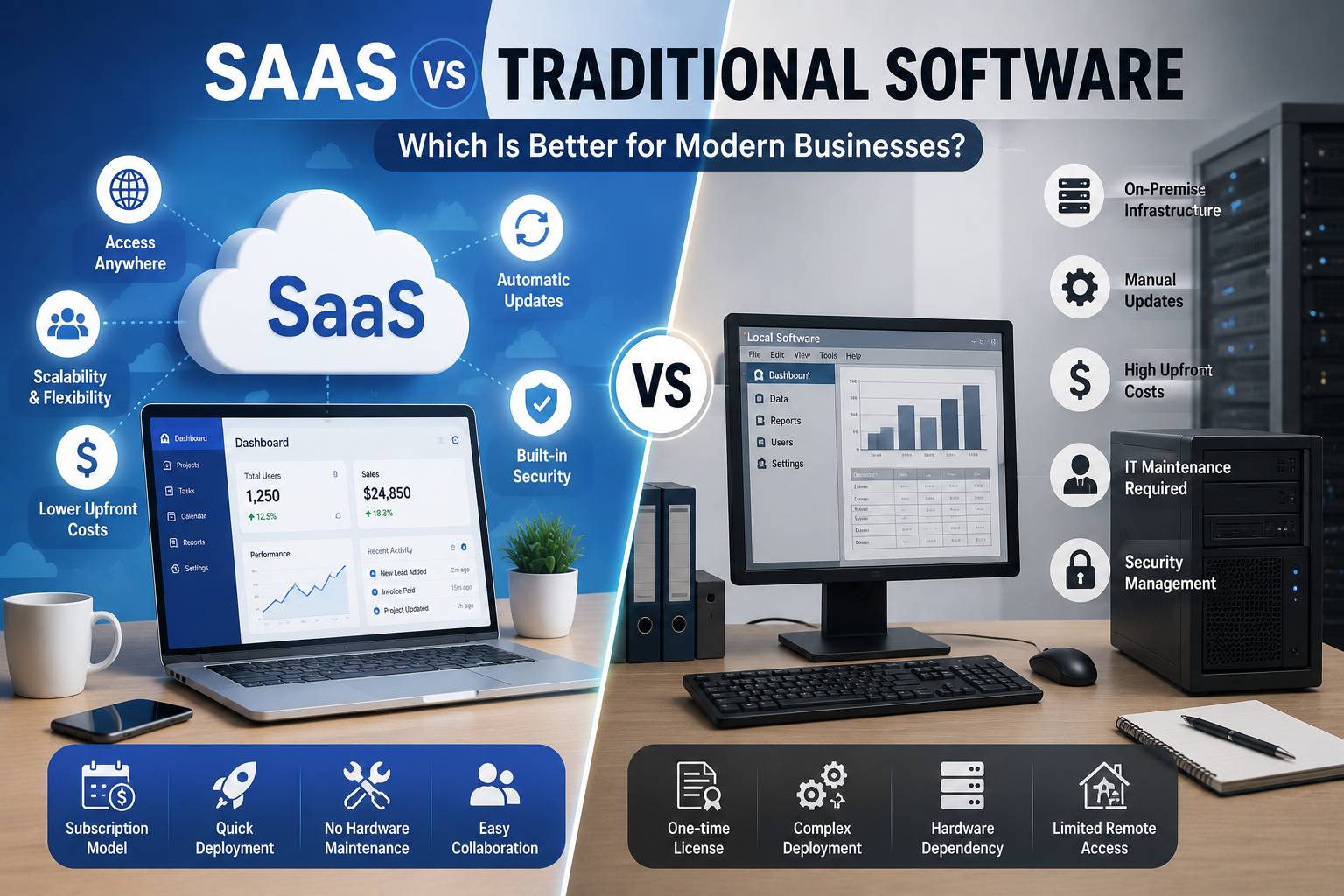
Businesses have more choices than ever when selecting software.
For decades, organizations primarily purchased traditional software licenses and installed applications directly on computers or company servers. Today, Software as a Service has become a popular alternative.
Both approaches have advantages and disadvantages.
The right choice depends on factors such as business size, budget, security requirements, internet connectivity, customization needs, and the type of software being used.
Understanding the differences can help organizations make better technology decisions.
What Is Traditional Software?
Traditional software is generally purchased or licensed and installed on local computers or servers.
The business may be responsible for installation, updates, maintenance, hardware, backups, and security.
For example, an organization might purchase a software license and install the application on computers within its office.
Some traditional applications can operate without a constant internet connection, which may be beneficial for certain environments.
What Is SaaS?
SaaS is software delivered through the internet.
The provider hosts the application and typically manages much of the underlying infrastructure.
Customers usually pay through monthly or annual subscriptions.
Users can access the software through web browsers or dedicated applications, depending on the service.
Examples include cloud-based accounting, CRM, project management, communication, and marketing applications.
Cost Comparison
Cost is one of the most important differences.
Traditional software can require a large upfront investment. Businesses may need to purchase licenses, servers, storage, networking equipment, and support services.
SaaS generally uses recurring subscription fees.
This can make SaaS easier for smaller businesses to adopt because costs are spread over time.
However, subscription expenses continue as long as the service is used.
A traditional software license may therefore become more economical over a long period in some situations, depending on the product and maintenance requirements.
Businesses should compare total cost of ownership rather than looking only at the initial price.
Installation and Maintenance
Traditional software usually requires installation on individual machines or company infrastructure.
Updates may need to be downloaded and installed manually.
SaaS reduces much of this burden because the provider manages the hosted application.
For businesses without dedicated IT teams, this can be a major advantage.
However, organizations have less control over when certain SaaS updates are introduced.
Accessibility
SaaS generally has an advantage when employees need to work from different locations.
A user can often access the application from home, the office, or while traveling.
Traditional software may be more dependent on the physical infrastructure where it is installed.
Although remote access can be added to traditional systems, doing so may require additional infrastructure and security measures.
Internet Dependence
SaaS typically requires internet connectivity.
If the internet connection is unavailable, access to the application may be limited depending on whether the service provides offline functionality.
Traditional software can sometimes continue working locally even when internet connectivity is unavailable.
For businesses operating in areas with unreliable connectivity, this factor can be important.
Customization
Traditional software can sometimes offer extensive customization, particularly when businesses control the underlying environment.
Organizations with specialized requirements may prefer software that can be modified extensively.
SaaS platforms vary widely in customization options.
Many provide configuration settings, extensions, APIs, and integrations, but customers generally cannot modify the entire underlying application.
For most businesses, configuration may be sufficient. Highly specialized organizations may need more control.
Updates
Traditional software gives organizations greater control over when updates are installed.
However, this also creates responsibility.
Businesses must monitor available updates and ensure that systems remain supported and secure.
With SaaS, providers generally manage updates centrally.
This allows users to receive new features and security improvements without performing extensive manual installations.
The trade-off is reduced control over the timing and nature of updates.
Security
Security depends heavily on implementation.
Traditional software allows organizations to control their own infrastructure, but this also means they are responsible for securing it.
SaaS providers typically invest heavily in security infrastructure because they operate the service for many customers.
However, SaaS customers remain responsible for account security, permissions, device protection, and appropriate configuration.
Neither model is automatically secure simply because of the delivery method.
Scalability
SaaS is often attractive for growing businesses.
Adding new users or increasing usage may require selecting a different subscription plan.
Traditional software may require additional hardware, licenses, or infrastructure as the organization grows.
However, SaaS pricing can also increase as usage expands, so businesses should understand how subscription costs scale.
Data Ownership and Portability
Businesses should understand what happens to their data in both models.
With traditional software, organizations may have direct control over databases and storage systems.
With SaaS, data is generally stored within the provider’s infrastructure.
Before choosing a SaaS platform, companies should understand:
- How data can be exported
- What happens after cancellation
- Data retention periods
- Backup procedures
- Migration options
- Contract terms
Data portability becomes especially important when software contains years of customer or financial information.
Vendor Dependence
SaaS creates a stronger ongoing relationship with the provider.
If the provider changes pricing, features, policies, or availability, customers may be affected.
Traditional software can also create vendor dependence, particularly when proprietary formats or specialized systems are involved.
Businesses should therefore evaluate the provider’s reputation, financial stability, support, and long-term roadmap.
Which Option Is Better for Small Businesses?
For many small businesses, SaaS is attractive because it minimizes infrastructure requirements and provides predictable access to modern applications.
A small company may not want to maintain servers or employ specialized IT staff.
Cloud software can provide access to sophisticated features without requiring extensive technical infrastructure.
However, businesses with highly specific requirements or limited internet access may find traditional solutions more suitable.
Which Option Is Better for Large Organizations?
Large organizations may use a combination of both models.
Some applications may be delivered through SaaS, while others remain on-premises because of security, compliance, legacy infrastructure, or customization requirements.
Hybrid technology environments are therefore common.
The question is not always “SaaS or traditional software?”
Sometimes the better question is “Which delivery model is best for each specific workload?”
Questions Businesses Should Ask
Before selecting software, organizations should consider:
- What problem does the software solve?
- How many users need access?
- Is internet access reliable?
- How sensitive is the data?
- How much customization is required?
- What is the five-year cost?
- Who manages security?
- How frequently is the software updated?
- Can data be exported?
- What happens if the provider shuts down?
- Does the software integrate with existing systems?
Answering these questions can reveal which model fits the organization best.
The Future of Business Software
The software industry is increasingly moving toward cloud-based services.
AI, automation, real-time collaboration, integrations, and browser-based applications are making SaaS increasingly capable.
At the same time, traditional and on-premises software will continue to play an important role in industries and organizations that require greater infrastructure control.
The future is therefore unlikely to be completely SaaS or completely traditional.
Instead, businesses will increasingly choose technology based on specific operational requirements.
Conclusion
SaaS and traditional software each have strengths.
SaaS generally offers easier deployment, remote accessibility, scalability, and reduced infrastructure management. Traditional software can provide greater control, offline functionality, and potentially deeper customization in certain environments.
There is no universal winner.
Modern businesses should evaluate software based on total cost, security, functionality, scalability, customization, data ownership, and long-term requirements.
For many organizations, a carefully selected combination of cloud and traditional technologies may ultimately provide the most practical solution.