Software as a Service has already transformed how businesses use technology. Instead of purchasing and installing complicated software packages, organizations can access cloud-based applications through subscriptions.
Now, another major transformation is taking place: artificial intelligence is becoming part of SaaS applications.
AI-powered SaaS tools can analyze information, automate repetitive tasks, generate content, identify patterns, assist customers, and support business decisions. As AI capabilities continue to improve, SaaS applications are moving beyond simple digital workflows toward more intelligent and automated systems.
For businesses of all sizes, this shift could significantly change how everyday work is performed.
What Is AI-Powered SaaS?
AI-powered SaaS refers to cloud-based software that incorporates artificial intelligence or machine-learning capabilities.
Instead of requiring users to manually perform every task, AI-enabled applications can assist with certain processes.
Examples include:
- AI writing assistants
- Automated customer support
- Sales forecasting
- Document analysis
- Meeting summaries
- Data analysis
- Personalized marketing
- Fraud detection
- Workflow automation
- Intelligent search
Because the software is delivered through the cloud, users generally do not need to build their own AI infrastructure.
Automating Repetitive Tasks
One of the most practical applications of AI in SaaS is automation.
Businesses perform countless repetitive activities every day. Employees may need to categorize emails, enter information into systems, summarize meetings, create reports, or respond to frequently asked questions.
AI can assist with many of these processes.
For example, an AI-enabled customer service platform may classify incoming questions and suggest responses. A productivity platform may summarize a meeting automatically.
Reducing repetitive work gives employees more time to focus on tasks requiring human judgment.
AI in Customer Service
Customer expectations have changed dramatically.
People often want quick answers regardless of the time of day. Traditional customer service teams may struggle to handle large volumes of requests.
AI-powered SaaS platforms can provide automated assistance through chatbots and virtual agents.
These systems can answer common questions, locate information, guide users through processes, and escalate complex issues to human representatives.
The goal is not necessarily to eliminate human customer service. Instead, AI can handle routine requests while employees focus on complicated or sensitive cases.
AI for Sales Teams
Sales departments generate large amounts of information.
Customer interactions, emails, calls, proposals, purchase history, and lead activity can all provide useful signals.
AI-powered CRM systems can analyze this information and help sales teams identify promising opportunities.
For example, AI may help prioritize leads based on customer behavior or identify accounts that appear ready for follow-up.
This can help sales representatives spend their time more strategically.
AI-Powered Marketing
Marketing teams can also benefit from AI-enabled SaaS platforms.
AI can assist with:
- Content ideas
- Email personalization
- Audience segmentation
- Campaign analysis
- Customer behavior analysis
- Search optimization
- Advertising optimization
Rather than relying exclusively on manual analysis, marketers can use AI to process large amounts of information quickly.
However, human review remains important because automated recommendations may not always understand brand values, cultural context, or customer sensitivities.
Smarter Data Analysis
Businesses collect huge amounts of data.
The challenge is not simply collecting information—it is understanding it.
AI can help analyze large datasets and identify patterns that may be difficult to detect manually.
For example, an analytics platform might identify unusual sales behavior, changing customer preferences, or potential operational problems.
Natural-language interfaces are also making data analysis more accessible. Instead of writing complex queries, users may be able to ask questions using everyday language.
AI and Productivity
AI is increasingly becoming a productivity layer inside SaaS applications.
A user might ask software to:
- Summarize a document
- Draft an email
- Create a project plan
- Generate a report
- Extract important information
- Rewrite text
- Identify action items
- Organize information
These capabilities can reduce the amount of time spent on administrative work.
The greatest value often comes when AI is integrated directly into the tools employees already use.
Personalization
Customers increasingly expect personalized experiences.
AI can analyze customer behavior and preferences to help businesses tailor communications, recommendations, offers, and content.
For example, an online business can use customer activity to recommend relevant products.
Marketing platforms can use behavioral information to determine which messages may be more relevant to specific audiences.
Personalization can improve engagement, but companies should use customer data responsibly and transparently.
AI Does Not Eliminate the Need for Human Judgment
One of the biggest misconceptions surrounding AI-powered SaaS is that businesses can simply automate everything.
AI systems can make mistakes.
They may produce inaccurate information, misunderstand context, or generate recommendations that are inappropriate for a particular situation.
Human oversight remains essential, particularly for financial, legal, medical, security, and strategic decisions.
Businesses should treat AI as an assistant rather than automatically assuming every AI-generated result is correct.
Data Privacy and Security
AI-powered SaaS introduces additional questions about data handling.
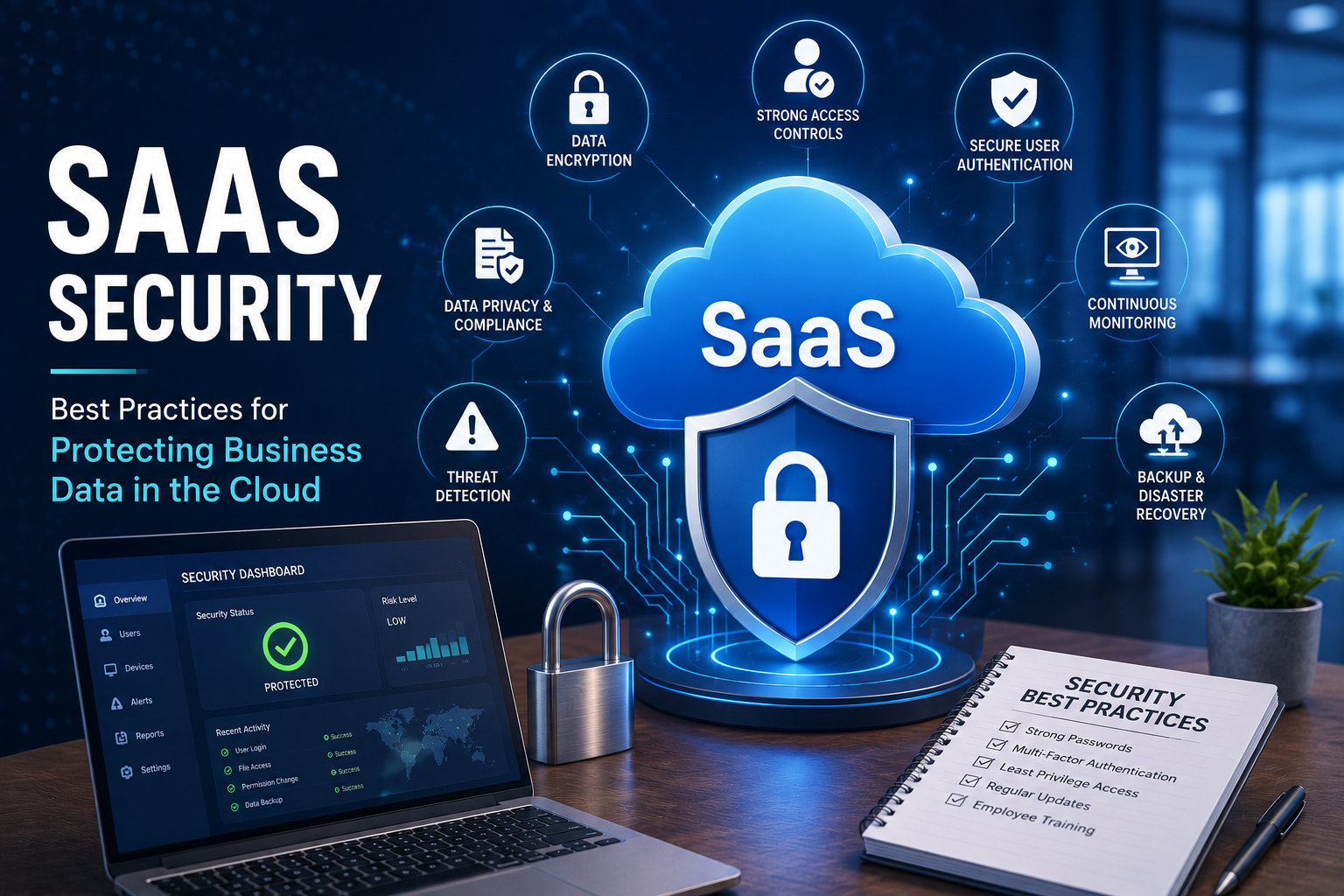
Before adopting an AI-enabled platform, businesses should understand:
- What data is collected?
- How is it stored?
- Who can access it?
- Is customer data used for model training?
- How long is information retained?
- What security controls are available?
- Can administrators control AI features?
Sensitive business information should not be entered into a platform without understanding its data policies.
Cost Considerations
AI features can sometimes increase SaaS subscription costs.
Businesses should evaluate whether AI capabilities actually solve meaningful problems.
A useful AI feature that saves employees several hours every week may justify additional expense. A feature that looks impressive but rarely gets used may not.
The focus should be on measurable business value rather than simply adopting AI because it is popular.
How Businesses Can Adopt AI SaaS Successfully
A practical adoption strategy can begin with a small number of use cases.
First, identify repetitive or time-consuming processes.
Next, determine whether AI can realistically improve them.
Run a controlled pilot and measure the results.
Useful measurements include:
- Time saved
- Cost reduction
- Employee productivity
- Customer satisfaction
- Error rates
- Revenue impact
If the results are positive, the organization can gradually expand AI usage.
The Future of AI-Powered SaaS
The relationship between AI and SaaS is likely to become even stronger.
Future applications may increasingly act as intelligent assistants capable of monitoring workflows, identifying problems, recommending actions, and completing multi-step tasks.
Instead of simply waiting for users to click buttons, software may proactively help employees achieve business objectives.
This could fundamentally change the user experience of business applications.
Conclusion
AI-powered SaaS is changing business software from passive tools into increasingly intelligent assistants.
From customer service and sales to marketing, analytics, and productivity, AI can automate repetitive work and help employees make better use of information.
However, successful AI adoption requires more than purchasing software. Businesses need clear objectives, responsible data practices, human oversight, and measurable performance goals.
Companies that combine AI automation with human expertise can potentially gain significant productivity advantages while maintaining control over important decisions.