Artificial intelligence has become one of the defining technologies of modern computing. Many AI applications depend on powerful cloud servers that process enormous amounts of information. However, another approach is gaining momentum: Edge AI.
Edge AI combines artificial intelligence with edge computing, allowing AI processing to occur closer to where data is generated. Instead of sending every piece of information to a distant data center, devices can perform at least some processing locally.
This approach could improve response times, privacy, reliability, and efficiency across industries.
What Is Edge AI?
Edge AI refers to running AI models on or near the devices that generate data.
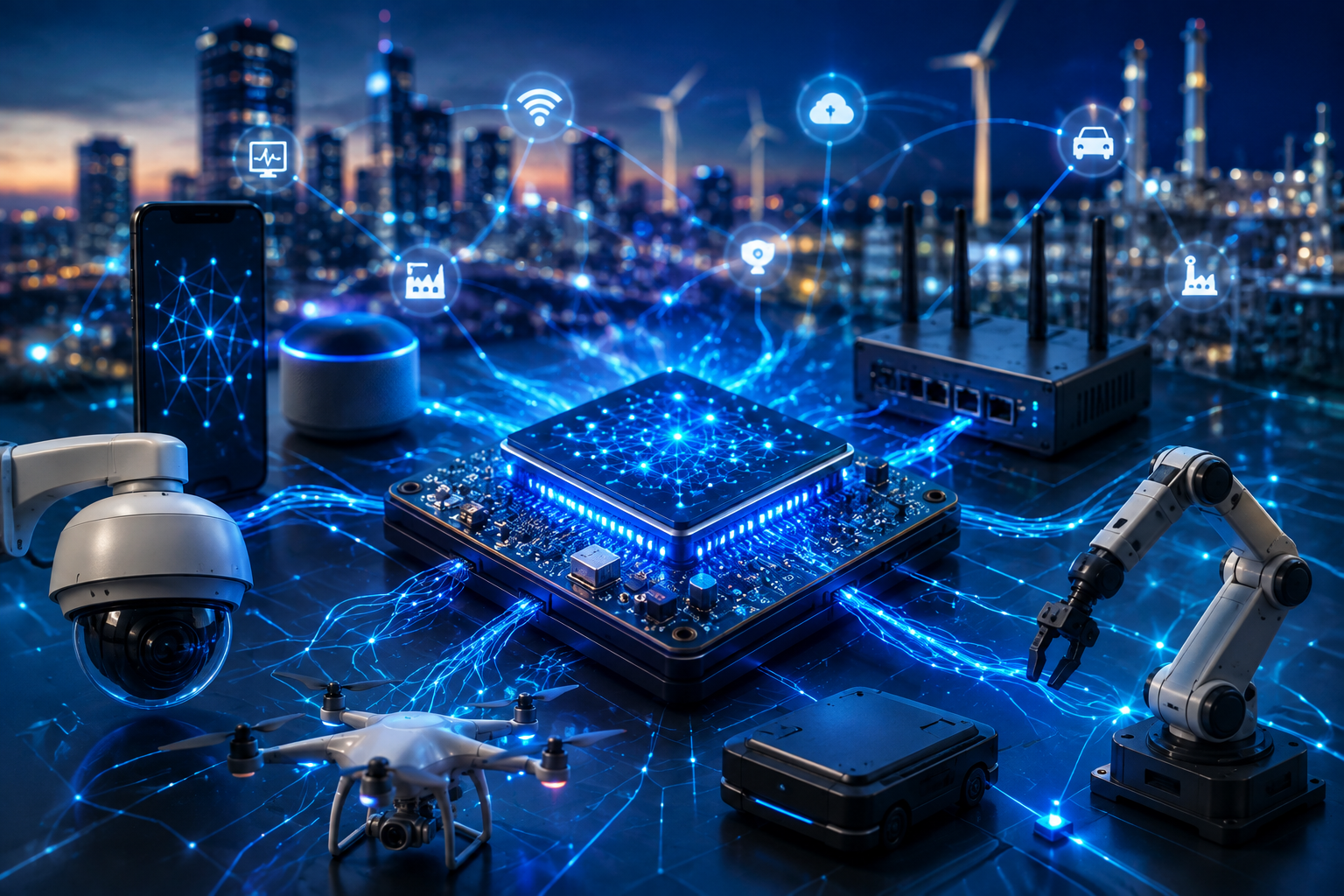
These devices may include smartphones, cameras, industrial machines, vehicles, sensors, robots, and Internet of Things equipment.
In a traditional cloud-based model, a device collects data, sends it to a remote server, waits for processing, and receives the result.
With Edge AI, some or all of the processing can happen locally.
This creates a more distributed approach to artificial intelligence.
Why Edge AI Matters
The amount of data generated by connected devices is growing rapidly.
Factories can contain thousands of sensors. Vehicles generate information about their surroundings. Smart cameras continuously analyze visual data. Consumer devices collect information through microphones, cameras, and other sensors.
Sending all of this information to centralized servers can consume bandwidth and increase latency.
Edge AI provides an alternative.
Faster Decision-Making
One of the biggest advantages of Edge AI is speed.
Applications that require immediate responses cannot always afford to wait for data to travel to a cloud server and back.
Consider an autonomous industrial robot. If its camera detects an obstacle, the system may need to respond almost immediately.
Processing the relevant information locally can reduce delays.
Similar benefits could appear in intelligent traffic systems, industrial safety equipment, robotics, and connected vehicles.
Edge AI in Smart Manufacturing
Manufacturing is an important application area.
Factories increasingly use cameras and sensors to monitor machines and production lines.
AI systems can analyze images to identify defects, detect unusual machine behavior, or monitor safety conditions.
With Edge AI, this analysis can happen close to the production equipment.
This can reduce dependence on continuous cloud connectivity and enable faster responses to problems.
Predictive maintenance is another opportunity. AI models can examine vibration, temperature, sound, and other sensor data to identify patterns associated with equipment problems.
Edge AI in Smart Vehicles
Vehicles are becoming increasingly computerized.
Modern vehicles use cameras, radar, lidar, GPS, and other sensors to understand their surroundings.
AI can help process these signals for driver assistance and other functions.
Edge processing is especially valuable because vehicles cannot depend entirely on an uninterrupted connection to the cloud.
Critical decisions must often be made locally.
Cloud services can still support activities such as software updates, fleet analytics, mapping improvements, and long-term data analysis.
Smartphones and Personal Devices
Edge AI is also moving into consumer electronics.
Modern smartphones increasingly include hardware designed to accelerate AI workloads.
Local AI processing can support functions such as image enhancement, speech recognition, translation, text assistance, and personalization.
One advantage is that some information can remain on the device rather than being transmitted to external servers.
This can improve privacy for selected applications.
Privacy Benefits
Privacy is an important reason organizations are exploring Edge AI.
Data processed locally may not need to leave the device.
For example, a smart camera could analyze video locally and transmit only an alert or a small amount of relevant information.
This does not automatically guarantee privacy. Devices still need strong security, appropriate data handling, and careful software design.
Nevertheless, reducing unnecessary data transfers can reduce exposure.
Edge AI and IoT
The Internet of Things connects physical devices to digital systems.
However, many IoT devices have limited processing power, memory, and energy.
Edge AI is helping change what these devices can do.
Instead of acting as simple sensors, devices can become intelligent systems capable of interpreting information.
A sensor might identify an unusual sound rather than continuously uploading raw audio.
A camera could detect a specific event instead of streaming every frame to a central server.
This can reduce network traffic and improve responsiveness.
Challenges of Edge AI
Edge AI also has limitations.
Devices at the edge generally have fewer computing resources than large cloud data centers.
AI models therefore often need to be optimized for memory, processing power, and energy consumption.
Security is another concern.
A cloud server can be located inside a controlled data center, while edge devices may operate in public spaces, factories, vehicles, or homes.
Physical access to devices can increase security risks.
Organizations must protect both the AI model and the underlying device.
The Importance of Specialized Hardware
Edge AI is closely connected with specialized processors.
Traditional CPUs can handle many tasks, but AI workloads can benefit from dedicated neural processing units and other accelerators.
These processors can perform AI calculations efficiently while consuming less power.
As AI becomes more common on edge devices, specialized hardware is likely to become increasingly important.
Edge AI and Generative AI
Generative AI has traditionally relied heavily on cloud infrastructure because large models require substantial computational resources.
However, smaller and optimized models are making local generative AI increasingly practical.
Future smartphones, computers, vehicles, and other devices may run selected AI assistants directly on the device.
A hybrid approach may become especially common.
Small tasks can run locally, while complex requests can be sent to powerful cloud models.
The Future of Edge Intelligence
Edge AI is likely to become an important part of the broader AI ecosystem.
Cloud computing will remain essential for large-scale training, centralized analytics, and complex workloads.
Edge devices will handle tasks where low latency, privacy, offline functionality, or reduced bandwidth is particularly valuable.
Together, cloud AI and Edge AI can create a more flexible computing architecture.
Conclusion
Edge AI represents a shift toward more distributed artificial intelligence. By moving selected AI workloads closer to users and data sources, it can improve responsiveness, privacy, reliability, and efficiency.
Its development will depend on better processors, smaller AI models, improved security, and efficient software.
As billions of devices become increasingly intelligent, Edge AI could become less visible but more important. Instead of thinking of AI as something that exists only in massive data centers, the future may involve intelligence embedded throughout the devices and environments people interact with every day.