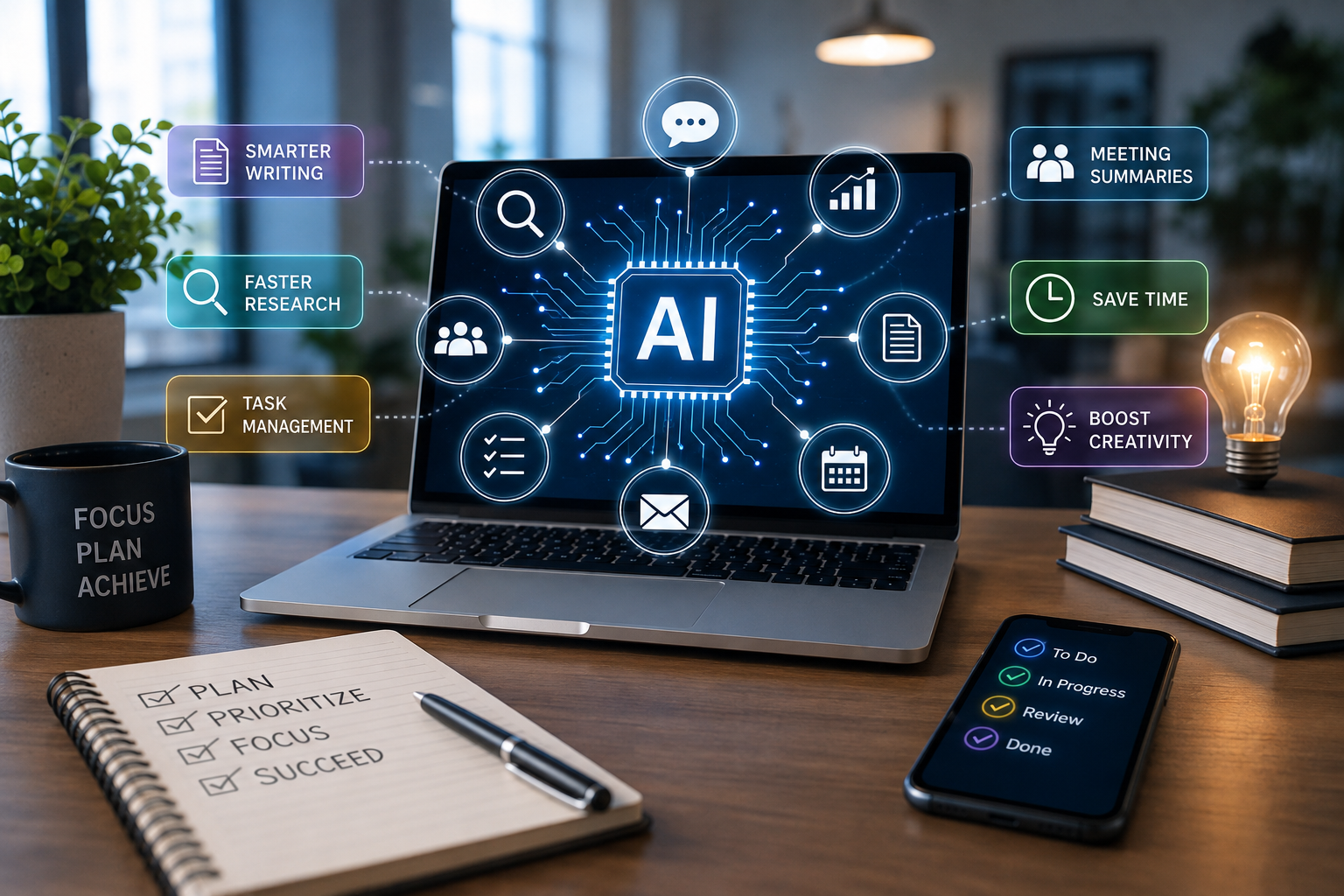
Artificial intelligence is no longer something limited to science-fiction movies or highly specialized technology companies. Today, AI has become part of everyday work, helping people write emails, organize information, analyze data, create presentations, manage schedules, and complete repetitive tasks more efficiently.
The rise of AI productivity tools is changing not only what we do at work but also how we approach our time, attention, and creativity. Instead of spending hours on routine activities, professionals can increasingly use AI to handle time-consuming tasks while they focus on decision-making, problem-solving, and meaningful work.
From freelancers and students to entrepreneurs and corporate teams, AI-powered productivity tools are becoming valuable digital assistants. However, using them effectively requires more than simply asking an AI tool to do everything. The real benefit comes from understanding where AI can save time and where human judgment remains essential.
What Are AI Productivity Tools?
AI productivity tools are software applications that use artificial intelligence to help users complete tasks more quickly or effectively. They can understand natural language, identify patterns, summarize information, generate content, organize data, and sometimes automate workflows.
Traditional productivity software generally requires users to provide specific instructions and manually perform many steps. AI tools can make the process more conversational and adaptive.
For example, instead of manually reading a 20-page document to identify its key points, an AI-powered tool can summarize the document and highlight important information. Similarly, instead of writing an email from scratch, a user can provide a few points and ask AI to turn them into a professional message.
These capabilities make AI particularly useful for tasks that involve large amounts of information or repetitive work.
Why AI Is Becoming Important for Productivity
One of the biggest challenges in modern work is not necessarily the amount of work itself, but the number of small tasks competing for attention.
Emails, meetings, notifications, reports, research, scheduling, documentation, and administrative work can consume a significant portion of the day.
AI can reduce this burden by helping with tasks such as:
- Writing and editing
- Summarizing documents and meetings
- Research and information organization
- Task management
- Data analysis
- Brainstorming
- Scheduling
- Creating presentations
- Customer communication
- Repetitive administrative work
The goal is not simply to work faster. Ideally, AI allows people to spend more time on tasks that require creativity, judgment, communication, and strategic thinking.
AI Can Automate Repetitive Tasks
Repetitive work is one of the clearest areas where AI can improve productivity.
Consider a professional who receives dozens of emails every day. Reading, categorizing, prioritizing, and responding to those emails can take hours. AI-powered email features can help summarize conversations, suggest responses, identify important messages, and organize information.
The same principle applies to many other workplace activities.
AI can assist with:
- Creating routine reports
- Extracting information from documents
- Categorizing customer inquiries
- Converting notes into structured documents
- Generating meeting summaries
- Creating task lists
- Drafting standard communications
When repetitive activities are reduced, employees can redirect their attention toward more valuable responsibilities.
AI Makes Writing and Communication Easier
Writing is another area where AI has had a significant impact.
Professionals often spend considerable time drafting emails, proposals, reports, social media posts, presentations, and other business communications. AI writing assistants can help generate a first draft, improve grammar, change tone, shorten lengthy content, or make complicated information easier to understand.
For example, a user could provide a few rough points and ask an AI tool to create a professional email. The user can then review and personalize the result.
This is particularly useful for people who know what they want to communicate but struggle with organizing their thoughts.
However, AI-generated writing should not automatically be treated as final. Human review remains important because AI can misunderstand context, produce inaccurate information, or use language that does not match the intended audience.
AI Helps With Research and Information Overload
The amount of digital information available today can be overwhelming.
Employees may need to read reports, research competitors, analyze customer feedback, review documents, or understand unfamiliar subjects before making decisions.
AI can help by quickly organizing large amounts of information and producing summaries.
For example, instead of reading multiple lengthy documents individually, a user may use an AI tool to identify:
- Main arguments
- Important statistics
- Common themes
- Differences between documents
- Key conclusions
- Questions that require further investigation
This can significantly reduce the time spent on the initial stage of research.
However, AI should be viewed as a research assistant rather than an unquestionable source of truth. Important facts, statistics, legal information, financial information, and other high-stakes details should always be verified using reliable sources.
AI-Powered Task and Time Management
Managing tasks effectively is another area where AI can become useful.
Traditional task-management apps allow users to create lists, deadlines, reminders, and project boards. AI can take this a step further by helping users prioritize and organize their workload.
For example, a user could provide a list of tasks and ask AI to organize them according to urgency and importance.
AI can help transform a long list such as:
- Reply to clients
- Prepare presentation
- Complete report
- Attend meeting
- Review invoices
- Research new project
into a more structured plan for the day.
Some AI-powered productivity systems can also help identify deadlines, break larger projects into smaller steps, and suggest schedules.
The important point is that productivity is not about filling every available minute with work. Good AI-assisted planning should also account for breaks, focus time, and realistic workloads.
AI Is Changing Meetings
Meetings are often necessary, but the administrative work surrounding them can be time-consuming.
AI meeting assistants can help with transcription, summaries, action items, and key discussion points. Instead of manually taking detailed notes throughout a meeting, participants can focus more closely on the conversation.
After the meeting, AI can help answer questions such as:
What decisions were made?
Who is responsible for each action item?
What deadlines were discussed?
What issues still need to be resolved?
This can make meetings more useful and reduce the amount of follow-up work required.
Organizations should nevertheless consider privacy and consent requirements before using AI tools to record or transcribe meetings, particularly when sensitive business or personal information is discussed.
AI Supports Creativity Instead of Replacing It
One common misconception is that AI productivity tools are designed primarily to replace human creativity.
In reality, they can also function as brainstorming partners.
A writer might use AI to generate potential article ideas. A marketer might ask for different campaign concepts. A designer could use AI to explore visual directions. A business owner might use it to identify possible solutions to a problem.
The human remains responsible for deciding which ideas are useful.
AI can generate possibilities quickly, but creativity still depends heavily on human experience, taste, context, and judgment.
The most effective approach is therefore not human versus AI, but human plus AI.
The Importance of Human Judgment
Despite the benefits of AI, there are limitations.
AI systems can occasionally produce incorrect information, misunderstand instructions, invent facts, or provide overly confident answers. They may also reflect biases present in their training data or fail to understand the nuances of a particular situation.
This is why human oversight remains essential.
A productive AI workflow should generally look like this:
Human provides context → AI assists with the task → Human reviews the result → Human makes the final decision.
This approach combines the speed of AI with human judgment.
How to Use AI Without Becoming Overdependent
The easiest way to become more productive with AI is to start small.
Choose repetitive tasks that consume time but do not require significant human judgment. For example, you might begin by using AI for:
- Email drafting
- Meeting summaries
- Brainstorming
- Document summarization
- Task organization
- Grammar and editing
- Creating first drafts
Once you become comfortable with these applications, you can gradually introduce AI into more complex workflows.
It is also important to protect confidential information. Before entering sensitive company data, personal information, financial records, passwords, or proprietary documents into an AI tool, understand how that tool handles and stores data.
The Future of AI Productivity
AI productivity tools are likely to become increasingly integrated into the software people already use.
Rather than opening a separate AI application, users may interact with AI directly inside email platforms, project-management systems, document editors, spreadsheets, calendars, and communication tools.
Future productivity systems may become more proactive. Instead of simply responding to commands, they could identify upcoming deadlines, summarize important information, suggest priorities, and help coordinate workflows.
This could fundamentally change the role of productivity software—from tools that simply store information to intelligent systems that actively assist with managing work.
Final Thoughts
AI productivity tools are changing the modern workplace by reducing repetitive work, accelerating research, improving communication, organizing information, and supporting creative thinking.
But productivity should not be measured simply by how much work can be completed in less time. The bigger opportunity is to use technology to create more space for strategic thinking, creativity, collaboration, and meaningful work.
The people who benefit most from AI may not necessarily be those who use the most tools. They are likely to be those who understand which tasks should be automated, which tasks require human judgment, and how the two can work together effectively.
AI is best viewed as a powerful assistant—not a replacement for human intelligence. When used thoughtfully, it can help people spend less time managing routine work and more time doing the work that truly matters.